







Measurement with the limits attached
Know what AI answers are doing with your brand
Some of the 500+ brands we've worked with
See all references














































Six signals, six questions
Decide what changed before deciding what to do


Brand Mention & Share-of-Model Tracking
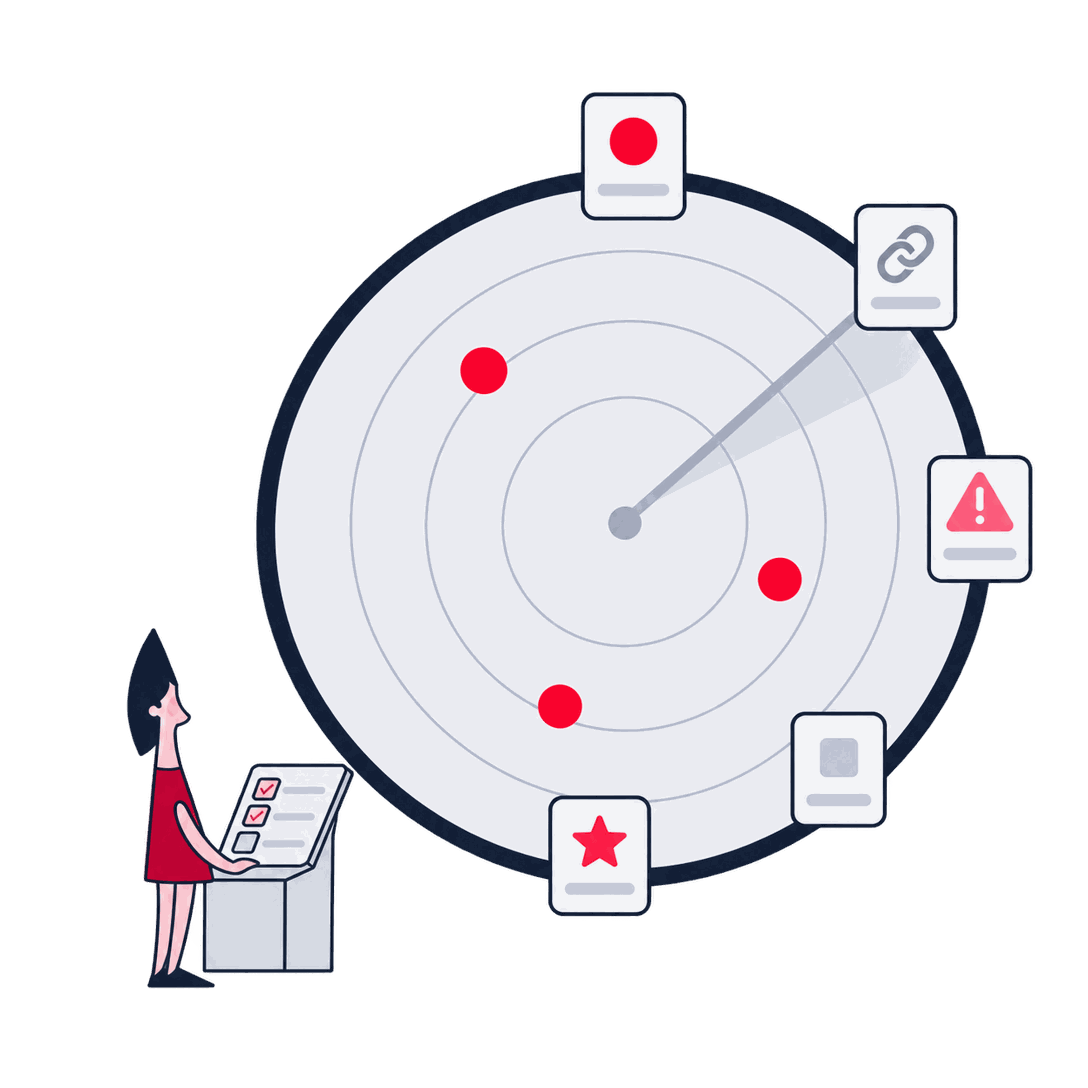
Citation & Source Tracking
Answer Accuracy & Claim Monitoring

Sentiment & Recommendation Analysis

Competitor Benchmarking & Regression Alerts


AI Referral & Assisted Conversion Measurement
Evidence before escalation
Noise does not become a task by default
The record shows what appeared, how often it appeared in the sampled panel, and which evidence sits behind the label. We compare the movement with a threshold agreed before collection. If it does not clear that threshold, it stays in the record without becoming an action item.
Where findings go next
The person who can change the cause receives the finding
Strategy defines the question universe. Technical, content, entity, and authority teams improve the conditions within their control. Monitoring reruns the panel, reports uncertainty and variance, then routes a supported finding to the person responsible for the relevant change.
Scope and ownership
Rules before dashboards, and a threshold agreed before collection
Noise does not become a task by default; a movement has to clear the agreed threshold to earn an owner.
Questions, platforms, markets, event definitions, denominators, validity rules, and known blind spots are fixed before the baseline is collected, and every repeated sample keeps its full answer context — failures included — on the same timeline as platform and interface changes. A specialist resolves unclear labels against the exact claims and sources, and mentions, citations, referrals, and outcomes keep their own separate measures rather than collapsing into one score. Strategy defines the question universe; technical, content, entity, and authority teams improve the conditions within their control; monitoring reruns the panel after an approved change and routes a supported finding to the person who can act on it.
Measurement needs rules before it needs a dashboard
Write down the panel rules
Questions, platforms, markets, event definitions, denominators, validity rules, and known blind spots are fixed before the baseline is collected.
Keep failed runs in the record
Every repeated sample retains its full answer context, including failures. Platform and interface changes stay on the same timeline.
A specialist resolves the grey areas
Unclear labels are checked against the exact claims and sources. Mentions, citations, referrals, and outcomes continue to use their own measures.
Escalate, assign, rerun
A movement goes to an owner only after it clears the agreed threshold. The panel runs again after any approved change is made.




Clients on the work
What it is like to work with Zeo
Our clients describe the work in their own words.


We were working with a global supplier on SEO before. Accessibility and process management were a little more difficult with these teams. At the same time, in terms of budget, global suppliers were more costly for us due to exchange rate differences and man-hours. When we started working with Zeo, we first went through an audit, fixing the results and problems. After these processes, we placed SEO in a strategic place for digital marketing and created an always-on SEO strategy for our brands and implemented it step by step.


As MediaMarkt, we have been working with Zeo for 6 years in a very tight and coordinated way to manage our SEO processes. We receive the highest level of feedback from Zeo on increasing and improving our organic traffic. It is very enjoyable to get fast support on all our issues 24/7 and to work with Zeo to better embrace and continuously improve our brand, and we recommend it to everyone.


We strictly follow the regulations and algorithms that can change at any time; We need to act quickly. At this point, Zeo has become a partner that meets all our expectations with its professional, innovative and solution-oriented approach. The Zeo team has become a stakeholder in success by looking at our optimization processes and our brand as their own value. As the Acıbadem Healthcare Group family, we would like to thank all the Zeo team, who work tirelessly, constantly improve, and do not compromise on keeping their energy high under all circumstances!


Besides increasing our website's visibility in the UK with Zeo, the experienced team that closely follows its work and has extensive experience in its field has always made us feel like we are in the right place for SEO. We are on the right track with Zeo in a country and industry where competition is high.


We talked to a number of agencies while we were planning our website's infrastructure migration, and we ended up with Zeo. They start by understanding the problem, then bring fresh approaches to solving it better. Communication is strong, and they support you at whatever point you turn out to need it. Every minute we spend working with them convinces us further that we made the right call. If you're looking for someone to sort out the digital side, you're in the right place.
Adjacent search evidence
Case Studies
Organic search engagements establishing the indexation, content depth, and domain authority that AI answer engines draw from.






People who watch how AI cites a brand
GEO work starts with recording what AI answers actually say about a brand today, then moves to the parts you can influence. The consultants below work on the specific capability this page covers.

Samet Özsüleyman
SEO Manager

Hande Parmaksız
SEO Manager

Ezgi Gülsen Yaylı
SEO Manager

Sena Önder
Senior SEO Executive

Elif Naz Akan Karakoç
Senior SEO Executive

Sinem Bakır Yavaş
Senior SEO Executive

Zafer Yıldız
Web Analytics Manager

Aybüke Göktuna
Senior SEO Analyst

Ruhan Tiryaki
Senior SEO Analyst

Burak Pehlivan
Co-founder & CEO

Mehmet Aktuğ
Co-Founder & COO

Metehan Urhan
New Business & Partnership Manager

Ataberk Yüzat
SEO Executive
Tools we use
What we watch AI answers with
Generative search leaves less to read than a rankings report does, so most of this work is assembling evidence from tools that were never built for it.
AI answer and citation tracking
- ProfoundThe measurement panel this page's roadmap runs on, and the sample size, denominator, and known blind-spot disclosure it insists accompany every result, is built from Profound's run-condition logging, the record that lets a specialist say what a given result can and cannot support before anyone acts on it.
- Peec AIThis page refuses a single visibility score because mentions and referrals have different denominators. Peec AI keeps the per-prompt, per-model structure that makes a denominator statable at all: a mention rate counted against the runs it was observed in, rather than a number with no sample behind it. That structure is also what lets a movement be traced to the slice that produced it.
- Otterly.AIThis page's own opening point, that one visibility score cannot say whether an answer mentioned, recommended, cited, or converted, is exactly what Otterly.AI's event-level tracking is built to preserve; its per-engine, per-event breakdown is what feeds the separate measurement described in the page's four child methods.
- SemrushCompetitor movement is one of the measures this page insists on keeping separate. Semrush covers it on both sides, tracking AI-answer presence through its AI Visibility Toolkit while the classic dataset holds the ranking picture for the same competitor. Reporting them side by side rather than as one figure is what lets a specialist say a rival gained in answers while losing in results, which is a different finding.
- SE RankingNot every engagement can carry a purpose-built AI visibility platform, and this page's answer to that is to be clear about what a measure can support rather than to pretend the coverage is equivalent. SE Ranking's AI Search add-on tracks AI Overview appearances and chatbot mentions inside the rank tracker an account already runs. We name which tooling produced a baseline, because two panels are not interchangeable.
Content evidence and sourcing
- AirtableThis page's own second section, keep failed runs in the record, is a discipline Airtable's structured rows enforce directly: a failed or ambiguous prompt run is logged with a status rather than silently excluded, which is what lets a specialist later distinguish a real regression from a bad sample.
Measurement and reporting
- Google AnalyticsThe conversion half of this page's measurement, distinguishing an AI-referred visit from an assisted or unattributed one, runs against GA4's own consented event data, since a referrer log alone cannot say whether that visit went on to convert.
- SimilarwebWhere retained referrer strings alone are ambiguous about which platform actually sent the visit, Similarweb's AI-channel segmentation gives the escalation step a second, cross-checkable read before a movement is labeled a genuine competitor gain rather than referrer noise.
- Looker StudioThis page's whole argument is that different measures answer different questions, which a dashboard usually flattens. In Looker Studio we build the view so each tile carries the run count or session set it was counted against, and mentions, citations, and referrals stay in separate charts. A dashboard that renders them as one trend line would contradict the measurement design it is meant to display.
- BigQueryThis page asks that a movement clear the range observed in the baseline before it is escalated, and that test needs the underlying runs, not a summarized score. BigQuery holds the retained answer and session records in their raw form, which is what lets a second analyst recompute a rate under the same rule. A number that only exists in a dashboard cannot be challenged that way.
- JupyterThe threshold on this page is set from observed variance rather than a round number, which makes the calculation itself something a client can question. A notebook keeps that calculation inspectable: the run set, the range, and the rule are code rather than a claim in a slide. When a reviewer disputes an escalation, they rerun the notebook against the same records instead of asking us what we did.
Set the decision first
Build a measurement your team can use

Interpreting a changing sample