






Form & Checkout Optimization
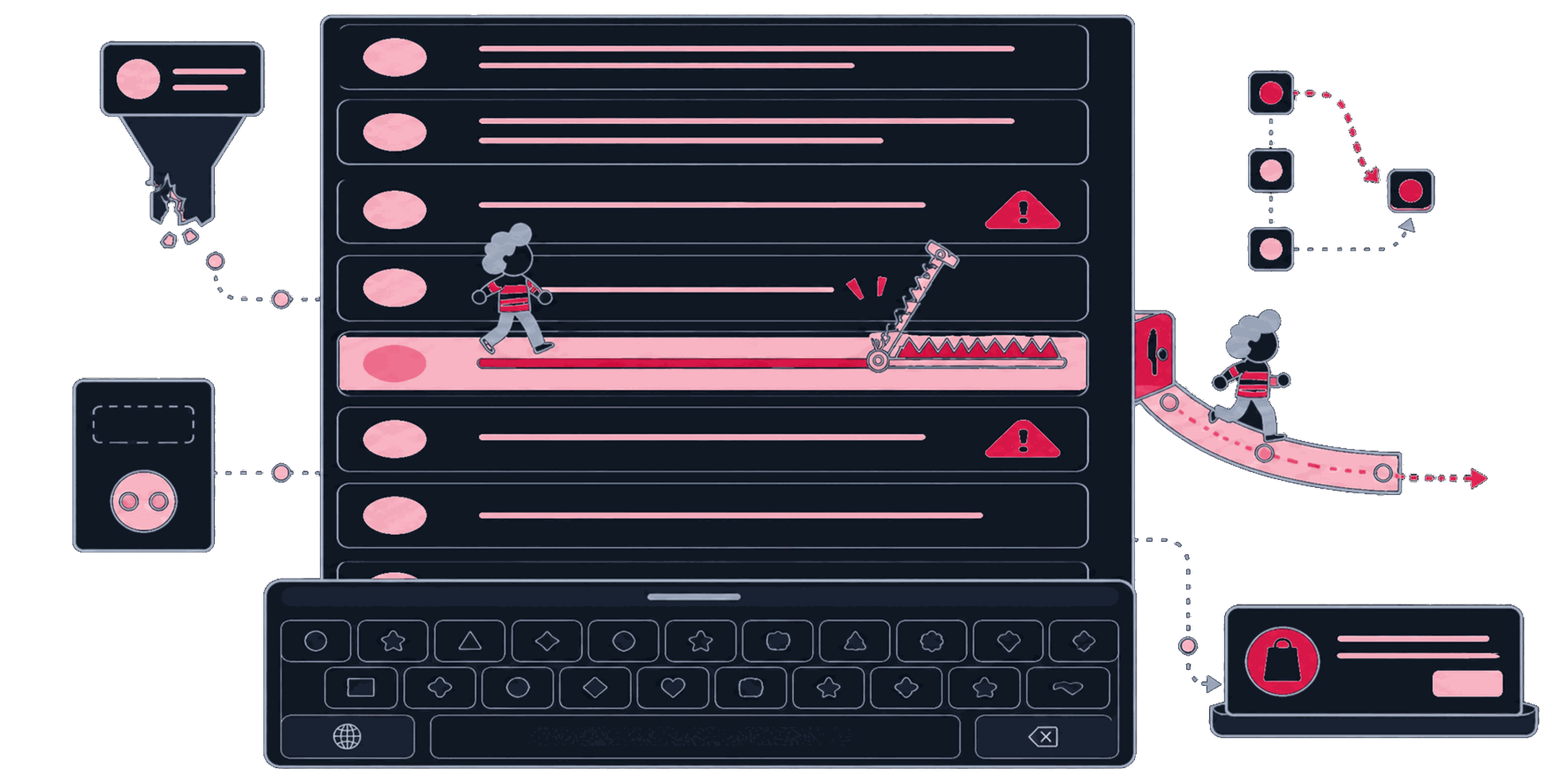
A funnel chart cannot show where field-level checkout friction occurs.
A step-level funnel report tells you that people leave during checkout. Field focus, error, and abandonment events show where. We read those events alongside session recordings, payment behavior, and scoped accessibility checks, then turn supported findings into hypotheses for test design. You get a field-by-field friction map for the form or checkout, followed by an experiment plan for the highest-opportunity changes. A known abandonment problem is the starting point. This diagnostic fits when the team needs field-level evidence to decide what to test.


Some of the 500+ brands we've worked with
See all references














































How the work runs
Find the field behind the funnel drop
Field events tell us where people hesitate, while recordings help explain what happened around that moment. AI can audit the tracking and rank the signals. Human reviewers confirm the evidence, including accessibility findings, and decide which hypotheses are ready for test design.
How we hold ourselves to it
- Measure abandonment by field
- Tie each finding to a field, error state, or step transition
- Every proposed fix enters test design
- Payment and trust questions need their own evidence
Instrument field-level events
Confirm or add tracking for field focus, field error, field abandonment, and time-to-complete per field. Step entry and exit remain useful, but they cannot identify the field where the problem occurs. The CRO strategist and analytics owner confirm the instrumentation is complete before evidence-gathering starts.
Field-level event coverage for focus, error, abandonment and time-to-complete, with the gaps that were closed listed.
Map abandonment to specific fields and steps
Read the field-level events against session recordings to see exactly where people hesitate, error out, or leave, separating a genuinely confusing field from one that's just slow to load. The research owner confirms the ranking against a sample of the underlying recordings.
Field- and step-level abandonment map read against session recordings.

Check payment and trust friction specifically
Compare offered payment methods with observed attempts. Around common hesitation points, review available security cues, pricing, and the displayed total. The client owner confirms payment-method changes are operationally feasible before they're proposed as fixes.
Payment-method and trust-cue findings comparing offered methods with observed attempts.

Check accessibility and input mechanics
Review labels, error announcements, mobile keyboard types, autofill compatibility, and focus order against relevant WCAG success criteria and input-type conventions. An accessibility-literate reviewer confirms flagged issues before they're added to the friction map.
Accessibility and input-mechanics findings against WCAG success criteria and input-type conventions.

Build the field-level friction map
Assemble findings about abandonment, errors, payment, and accessibility into one map ordered by estimated opportunity, so the highest-friction field is clearly prioritized. The CRO strategist signs off on the ranking before it becomes a test plan.
Friction map ordered by estimated opportunity across abandonment, error, payment and accessibility findings.


Turn the top findings into an experiment plan
Convert the highest-ranked friction points into falsifiable hypotheses ready for test design. The map informs the next test, and no fix ships from the diagnostic alone. The CRO strategist and client owner approve which hypotheses move to test design next.
Falsifiable hypotheses for the top-ranked friction points, ready for test design.

What lands with your team
What supports each field-level finding
These records connect the tracking setup to what people did, what reviewers confirmed and which ideas are ready for an experiment.
Field-level event audit
What's tracked at the field level today, what's missing, and what got added to close the gap.
Abandonment and error ranking
Every field ranked by abandonment rate and error frequency, with linked session recordings for the top entries.
Payment and accessibility findings
Observed payment-method mismatches and field-level accessibility issues reviewed against relevant WCAG criteria.


Field-level friction map and experiment plan
The ranked map plus falsifiable hypotheses for the top opportunities, ready for test design.
Before the work starts
When this work is the right next step
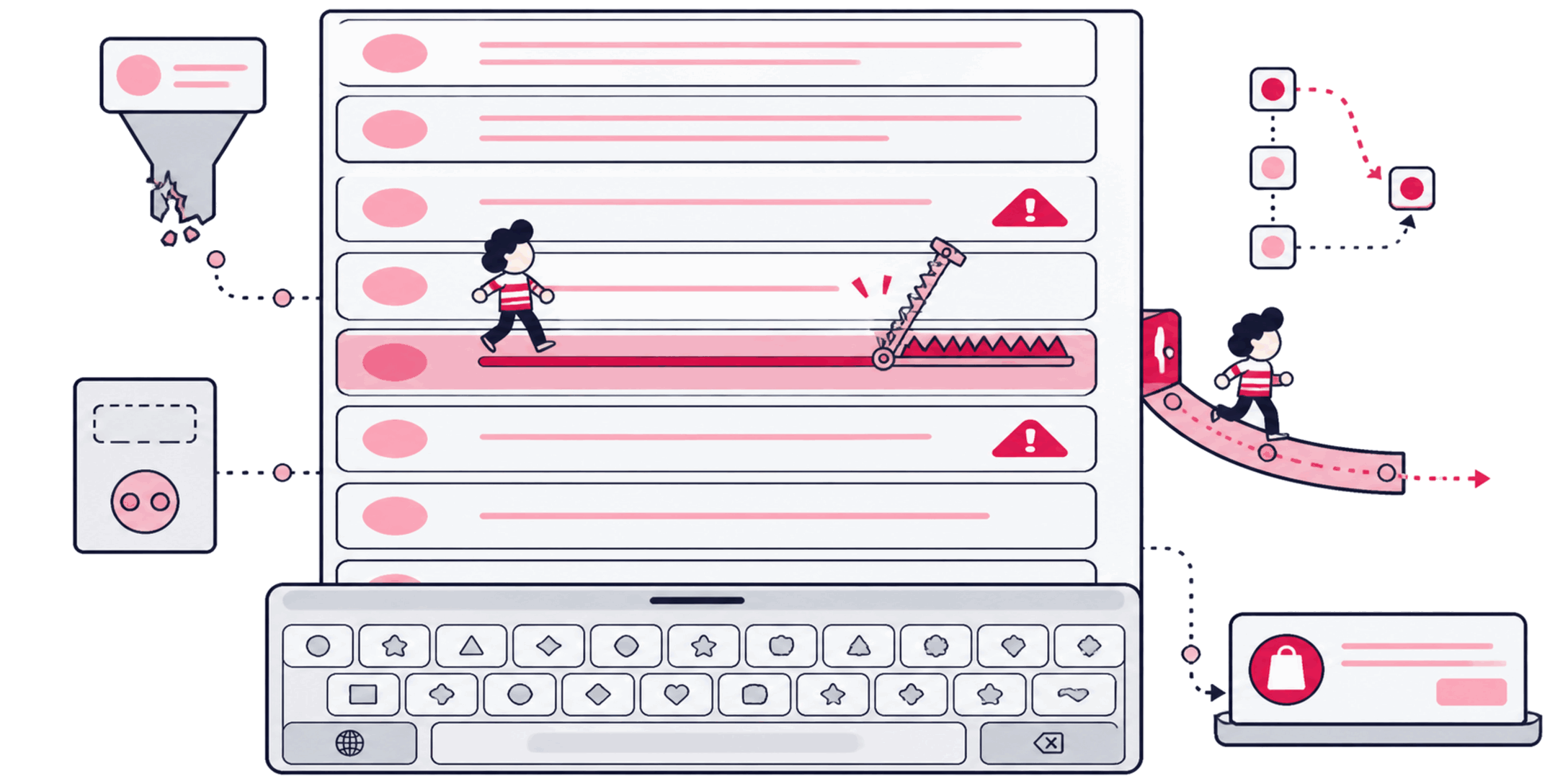
A checkout can pass design review and still lose users at a single field. A form may look clean in the design file while an offered payment method is missing or an error appears only after someone moves on. A step-level chart cannot expose either issue. Field events show the point of hesitation when the tracking exists.
A good fit when
- The form has enough completions and abandonments to expose field-level patterns, but the funnel report still stops at the checkout step.
- Focus, error, and abandonment events are missing for key fields, so nobody can distinguish a confusing input from one that simply loads slowly.
- Design and engineering can change the checkout, yet they need a ranked friction map to decide which field deserves a test first.
- Step-level drop-off with no field-level explanation.
- An error appears after the user moves on or tries to submit.
- Mobile opens the wrong keyboard for the input type.
- A friction recommendation ships without field-level data.
Better handled as other work when
- Form volume is too low for each field to produce a reliable read, so a step-level diagnostic is the highest confidence the data can support.
- One diagnosed defect already explains the loss, so a clear fix ticket for the submit button or error state should precede broader optimization.
- Nobody can change the checkout in this release window, so field-level evidence cannot reach test design.
People who own a single channel
Paid Search, Paid Social, CRO, and Programmatic each run under a named owner at Zeo. The consultants below are matched to the channel this page is about, so you can see who you'd actually work with.

İlker Emir
Senior Performance Marketing Executive

Zafer Yıldız
Web Analytics Manager

Sevda Yurtvermez
Performance Marketing Team Lead

Serap Yurtvermez
Performance Marketing Team Lead

Abdullah Tanıdır
Performance Marketing Team Lead

Onur Durdağı
Performance Marketing Executive

İpek Ezer
Performance Marketing Executive
Tools we use
Tools behind this work
 Contentsquare
measures interaction one field at a time, not the page as a whole
 Baymard Institute
the external benchmark for a checkout field's likely mistake
Related work


Parent service
CRO & Experimentation
This diagnostic ends at a ranked field map and test-ready hypotheses; the experiment contract, QA gate and production decision that carry one of them to launch are CRO's to write.


Where a fix becomes a test
A/B Test Design & Analysis
The method that takes a field-level hypothesis from this diagnostic and designs it into a properly powered experiment.


Wider-scope sibling
Funnel Friction & Journey Diagnostics
The multi-step journey this form or checkout sits inside, for when the cause traces further upstream.
Move past the step-level drop
Find the fields that need a closer look