













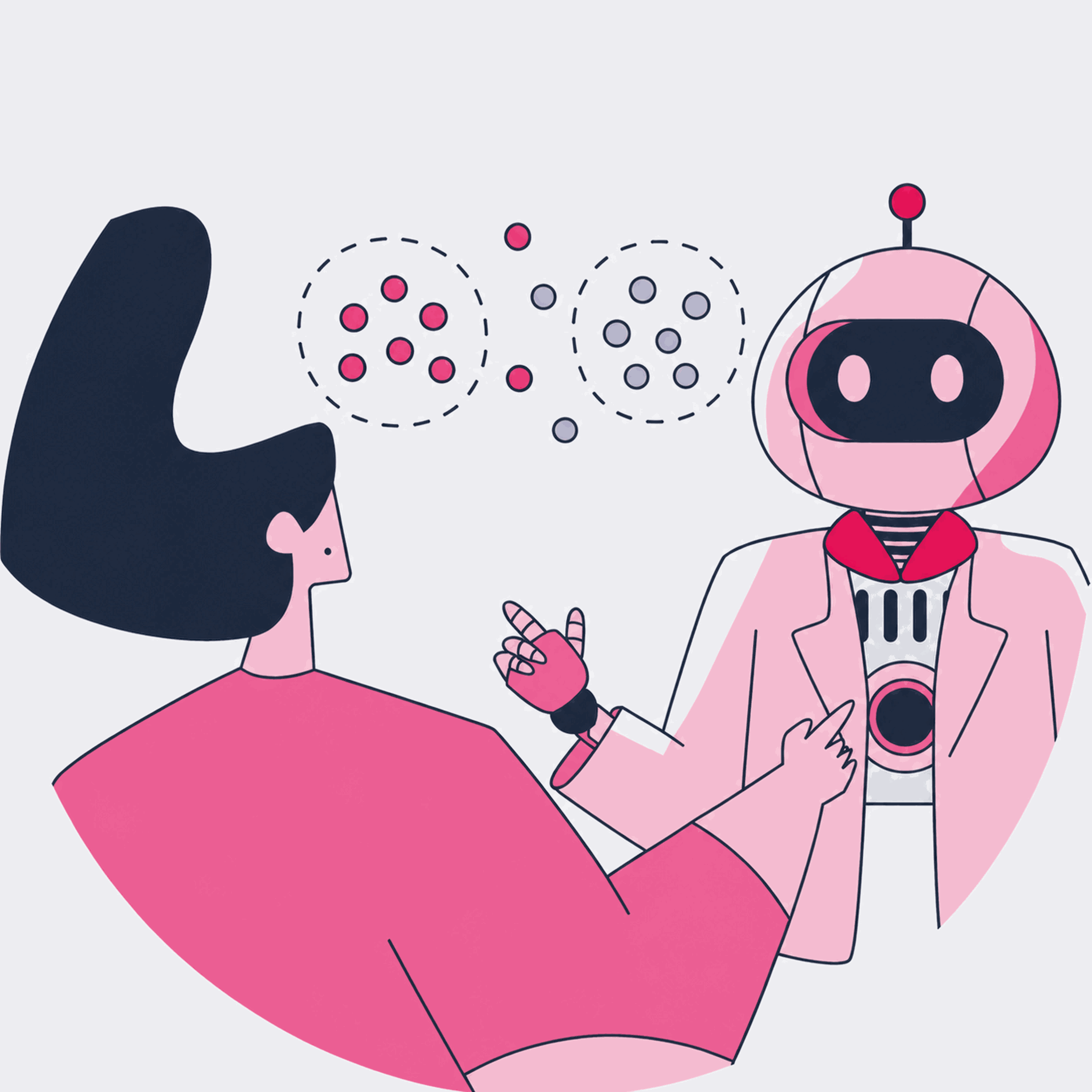
Unsupervised learning is a model finding structure in unlabelled data. Nobody supplies the right answer. The model looks only at the inputs and works out for itself which examples resemble each other, along which axes the data varies, and what looks unusual.
There are three main branches. Clustering splits similar examples into groups, with k-means and hierarchical clustering as the typical methods. Dimensionality reduction compresses hundreds of variables into a few components, PCA being the best known. Anomaly detection flags records that do not fit the majority. Pre-training in modern language models sits close to this family, since the text supplies its own labels and no hand-annotated set is required.
What separates it from supervised learning is the cost of labels. When you hold millions of records, labelling them one by one is usually out of reach, while unsupervised methods work on the raw data.
A concrete case: an ecommerce site has purchase histories for 300,000 customers and no defined segments. Running clustering produces four natural groups. One collects one-off discount buyers, another regular customers with small baskets. Naming those groups and building campaigns around them is human work.
Measuring whether the result is correct is hard. With no ground truth to compare against, the only real test of the clusters is what happens on the business side.