







Zeo delivery method
Content & Keyword Optimization
One URL owns one search task, every priority question has a chosen home, and the live copy still says only what the business can prove.
Ranking for a long list of phrases is no proof a page actually answers any of them well, and piling on more keywords won't fix a confused page purpose or two URLs quietly competing for the same search task. We define each page's one real job, separate the questions that don't belong on it, and rewrite the page around the answer that job actually needs before we publish and compare results. Each page gets one clear search job, and every claim on it stays tied to approved truth.


Some of the 500+ brands we've worked with
See all references




























Stages and gates
How we do it
Defining the page's job comes first, and everything else follows from getting that right. We sort the queries, rewrite what's useful, and check what changed once it's live.
Define the page's actual job
We combine query-to-page data with representative search results and the page's business purpose, then name the audience, task, exclusions, and one URL that should own it. The page owner names the one URL that should own the job and signs off the excluded intents.
A short intent brief that tells everyone what this page is, and isn't, meant to answer.


Separate questions that don't belong together
We group queries by task, funnel stage, expected format, and ambiguity. An SEO specialist resolves the queries the clustering leaves ambiguous and confirms what gets ignored.
A query map that shows what stays on this page, what needs another destination, and what should be ignored.


Rewrite around the useful answer
We map the approved questions and claims to the current headings and sections, keep what's working, remove repetition, and write only the gaps the evidence supports. The claim owner confirms every rewritten line still matches what the business can honestly say, and an editor signs off the copy.
A reviewed change set for titles, headings, copy, and links, with every material claim owned.


Publish, compare, and decide
We verify the rendered page matches the approved draft, then compare the same query, landing-page, and task segments after the agreed observation window. The page owner decides whether the result justifies keeping, revising, consolidating, or stopping the change.
A clear decision to keep, revise, consolidate, or stop.


AI sorts and drafts; the people who own the page and the claims decide.
AI clusters the incoming query set by apparent task, flags any query already landing on more than one URL, drafts candidate section rewrites and heading options once the approved questions and claims are in, and assembles the matched query, landing-page, and task segments into one comparison when the observation window closes. It does not set the page's job or its claims. We do not write to a keyword-density target, we do not invent product facts, statistics, testimonials, or expertise, and we do not add sections just because every competing result has one.
Deliverables and acceptance
What you get
What the page is for stays visible the whole way through, from the first query map to the decision after launch.
Brief
Intent & page-ownership brief
Decision matrix
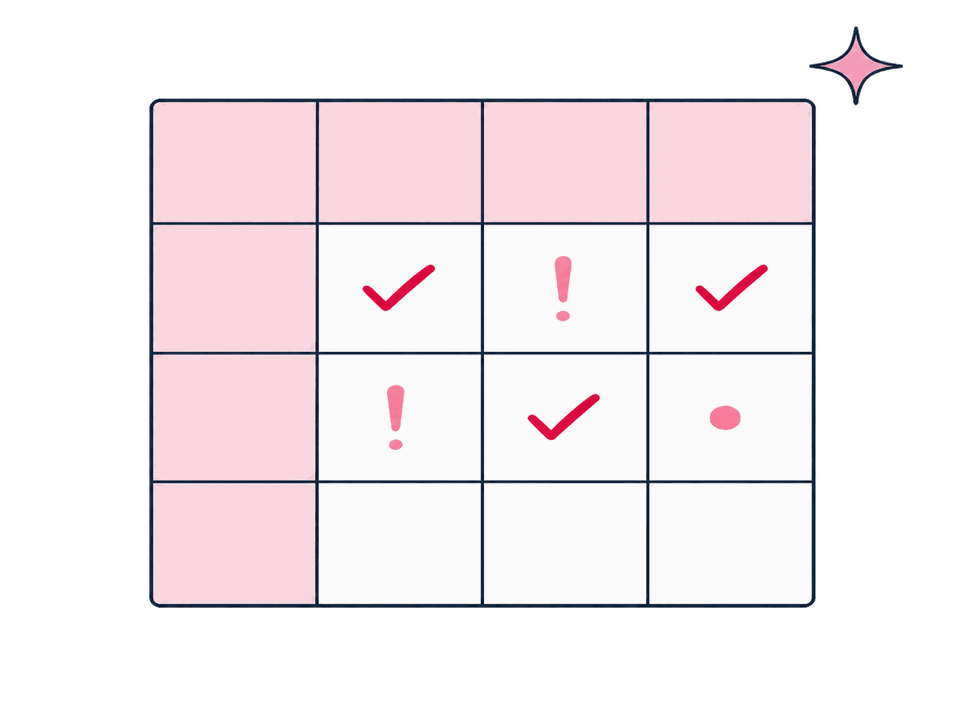
Query & section coverage map
Tracking plan
Reviewed optimization change set


Evaluation sheet
Coverage & outcome record
We call it done when: The intent brief, coverage map, change set, and outcome record are done when one owning URL is named with its excluded intents, every priority question has an approved answer location, each accepted change traces back to the brief and its source material, and the outcome record reuses the baseline segments and names who decides next.
Fit and readiness
When you need this
The right keyword is not something you sprinkle into a paragraph. It's shorthand for a question the page either answers or doesn't.
A good fit when
- A page is attracting mixed queries, the wrong audience, or several intents that don't belong in one answer.
- The page has the right purpose but skips important questions, proof, entities, or next steps the search journey actually needs.
- Two or more pages compete for similar queries and nobody has decided which one owns the job.


Better handled as other work when
- You want to hit a fixed keyword density without changing the page to answer a clearer user need.
- Nobody can confirm the product facts, brand language, or page purpose behind the copy.
If one of these is closer to your situation, start here instead: On-Page SEO
We call it done when: One page owns one coherent search task, every important question has a chosen place where it gets answered, and the live copy matches the draft that was reviewed, with its claims and its accessibility intact.
The specialists behind this SEO work
Zeo's SEO work goes back to 2006, when we started what we call the first SEO blog in the MENA region. The consultants shown here are doing that work today, matched to what this page covers.

Can Mutioğlu
Senior SEO Executive

Metehan Urhan
New Business & Partnership Manager

Aybüke Göktuna
Senior SEO Analyst

Yiğit Konur
Founder & Chief Strategy Officer

Samet Özsüleyman
SEO Manager

Elif Naz Akan Karakoç
Senior SEO Executive

Sena Önder
Senior SEO Executive

Bensu Tınastepe
Senior SEO Analyst

Ali Özgün Öz
SEO Executive

Ruhan Tiryaki
Senior SEO Analyst

Yağmur Bayram
Sr. SEO Analyst

Emir Kağan Kahveci
SEO Analyst

Burak Pehlivan
Co-founder & CEO

Deniz İmre Temiztürk
Content Specialist

Ataberk Yüzat
SEO Executive
Content we've produced on this topic
Tools we use
Tools behind this work
 Ahrefs
ranking-page comparison and competing topic footprint review
 Screaming Frog
title, heading, canonical, and competing page inventory
 Keyword Cupid
search-intent clusters for one clear owning page
 AlsoAsked
follow-up question paths and missing answer discovery
 Clearscope
draft coverage checks against the reviewed search-result set
 Google Search Console
query-to-page evidence, overlap, and post-release segment comparison
 Google Analytics
organic landing segments and qualified task completion checks
Where this fits
Related services


On-Page SEO
HTML & Structured Markup
Optimized on-page copy coordinates with semantic HTML tags, heading hierarchies, and entity markup to clarify subject context for crawlers.


On-Page SEO
Internal Linking & Page Flow
Optimized topic pages inject contextual in-body anchor links to guide search authority and user navigation toward transactional pages.

On-Page SEO
User Experience & Engagement Signals
Content readability, skim-friendly layout, and clear call-to-action blocks ensure ranking pages keep visitors engaged and reduce bounces.
Next step
Give the page one clear job


Before we start