




AI Training · Teachers & Educators
AI Training for Teachers & Educators
Lesson preparation, differentiation, feedback, and research checks turn into faster, reviewable workflows here. This hands-on training helps classroom practitioners use generative AI without handing over grading or judgment. No decision about a student moves to the tool.
- modules
- 6
- hours
- 13
Why this training
Why AI for this team?
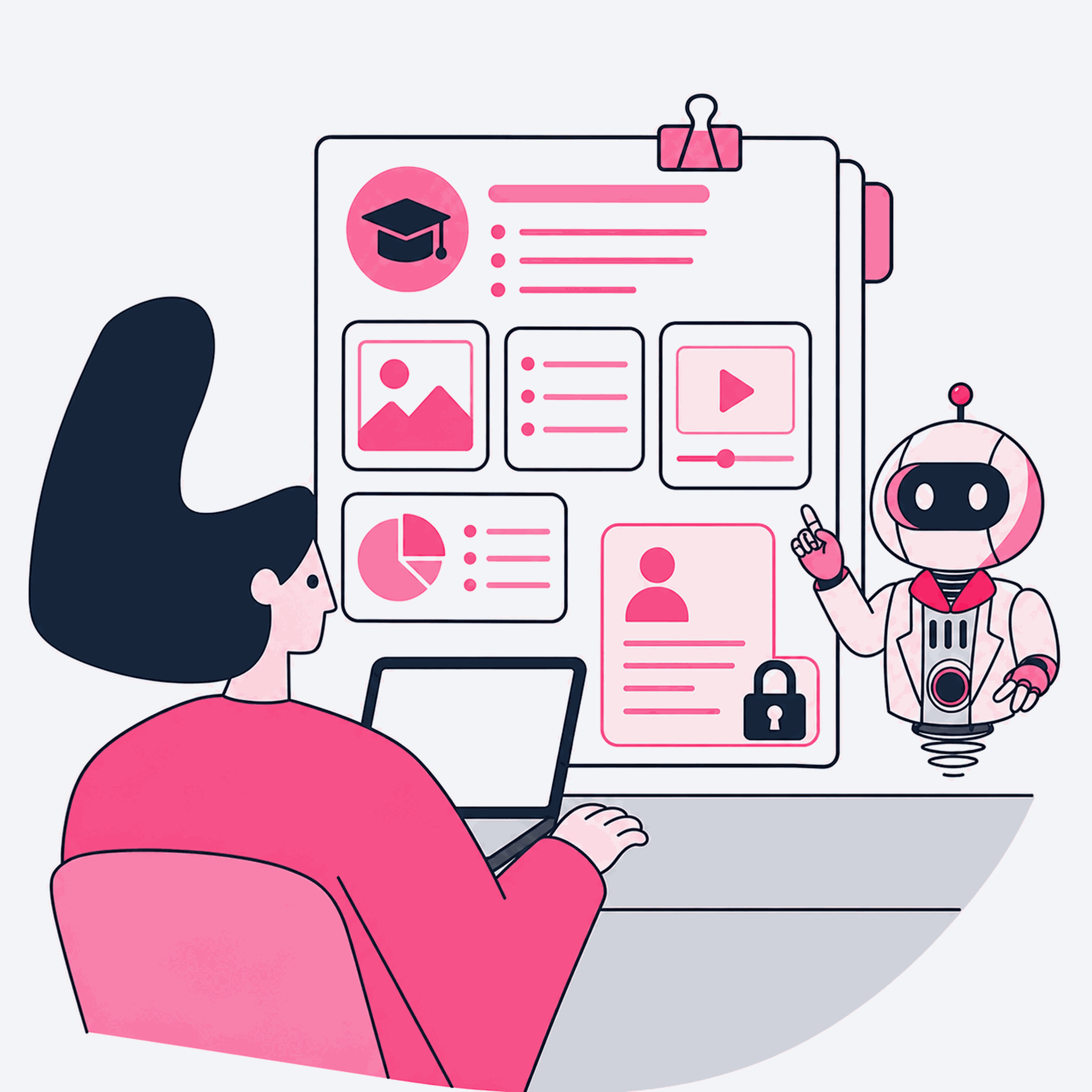
A chatbot will hand a teacher a polished lesson plan and clean rubric, along with finished-sounding quiz questions. None of that guarantees the material fits the class in front of them. Worksheets, examples, rubrics, and feedback drafts sound fluent even when a concept, reading level, or assumption fails. The checking step is where a teacher's judgment does the real work.
Differentiating one activity for different reading levels or access needs is a design decision a model cannot make alone, however convincingly it writes the result. Assessment works the same way: a fluent rubric or question bank still needs someone who understands the learners to catch ambiguity and bias. A leaked answer must be caught before it reaches a desk too.
What a teacher gets from AI is a faster first draft, one they can inspect, adapt, and stand behind in front of a class. The judgment about whether it is right for these students never leaves the room.
This page is written for the person standing in front of the class. Governance and procurement belong to the separate AI training program for education organizations, along with institution-wide policy. The daily judgment calls of teaching live here.
Preparation time belongs to teaching
A model can draft lesson outlines, examples, worksheets, and extension activities in minutes for a teacher to check and fit to the room, saving hours of drafting and revision.
One activity, several reading levels, one afternoon
Adapting a single activity for different reading levels and language needs is worth doing. Access requirements deserve the time too, yet the work rarely gets the time it deserves. A well-built prompt turns a shared learning objective into several options, and a teacher still reviews each one for fairness and fit.
A fluent rubric is not the same as a correct one
A model can produce questions, rubrics, and model answers that read perfectly well, but it has no way to know whether they measure what the lesson was teaching. A teacher who understands the tool can catch ambiguity, bias, answer leakage, and mismatched difficulty before any of it reaches a desk.
Banning AI teaches students nothing about using it well
Students already run into generated text, images, and search summaries outside the classroom, whether or not a school addresses it. What helps is teaching source checking and disclosure. Students also need the difference between using AI to learn and using it to skip learning.
The grade stays with the teacher, always
AI can organize evidence and draft feedback language a teacher then reviews, but it does not grade a student or decide on placement, discipline, progression, or support. Training makes that boundary explicit and makes the teacher's review a visible, checkable step in every workflow.
Syllabus
Training syllabus
Generative AI foundations built for the classroom
120 minBeginner
A clear picture of what language models can and cannot do in a teaching context, including why polished output can still be wrong. Participants leave knowing how to pick a low-risk task that stays easy to check.
- What happens between a prompt and an answer
- Hallucinations, hidden assumptions, bias
- Classroom tasks worth handing to AI, and decisions that are not
- Weighing a consumer chatbot against an institution-approved tool
- A checklist before anything reaches a student's screen
Prompt craft built around the learning objective
120 minBeginner
A reusable structure (objective, learner context, source material, format, and checks) practiced on material from the participant's own subject and age range instead of a generic demo.
- Building a focused drafting brief from a learning objective
- Sequences, explanations, examples, activities
- Giving useful context without naming a single student
- Asking the model to show its assumptions and its sources
- Improving a weak first draft through iteration
- Building a personal library of prompts that already work
Differentiation and accessibility in inclusive materials
135 minIntermediate
One core activity becomes several carefully reviewed alternatives for different readiness, language, and access needs, without labeling any student by the version they receive. The learning goal stays identical across every version. Only the material options change.
- Adjusting reading level while the core concept stays intact
- Scaffolds, extensions, alternatives
- Plain-language versions with accessible content structures built in
- Supporting multilingual learners without a single personal detail exposed
- A check for stereotypes and lowered expectations in adapted material
- Teacher review before any adaptation gets assigned
Questions, rubrics, feedback, and teacher-led assessment
165 minIntermediate
Assessment components and feedback come together faster here, while interpretation and final judgment stay the educator's job throughout. AI can draft, but it does not grade, rank, diagnose, or decide anything consequential about a learner.
- Question banks that cover more than one level of cognitive demand
- Rubrics and success criteria built from a single learning objective
- A check for ambiguity, leakage, bias, and mismatched difficulty
- Feedback stems grounded in evidence the teacher provided
- Personalizing a draft without inventing an observation that never happened
- Grades and student decisions that never leave human hands
Research and source checks for classroom AI literacy
135 minIntermediate
A dependable routine for checking AI-assisted research, captured as something a class can practice. Participants design activities that ask students to trace a claim, find its original source, disclose AI help, and explain their own reasoning.
- Telling a plausible claim apart from a verified one
- Tracing a citation back to its original, appropriate source
- Checking an AI answer against curriculum-approved references
- Designing assignments where the reasoning has to show
- Disclosure, attribution, responsible use
- Talking through synthetic media and generated misinformation with a class
Student data and integrity in classroom policy
105 minAdvanced
Privacy duties and academic integrity turn into daily decisions. Institutional rules also become choices decisions a teacher can make on a busy school day. Each participant leaves with boundaries for tools, data, review, and escalation that line up with their institution's policy.
- What student data has to stay out of an unapproved tool
- Anonymized and synthetic examples for safe practice
- Where academic-integrity rules draw the line between support and substitution
- Why a detector alone is not a decision method
- Documenting teacher review inside an AI-assisted workflow
- Lining classroom practice up with institutional policy and safeguarding
Outcomes
Outcomes & audience
What you will learn
- Turn a clear learning objective into a lesson plan, explanation, example set, or activity draft
- Adapt one material for different levels or access needs without lowering what it teaches
- Rubrics checked before release
- Produce feedback drafts grounded in evidence a teacher already gathered, while grading and student decisions stay with the teacher
- Check an AI-generated claim against its source before it goes anywhere near classroom material
- Your disclosure and source checks
- Protect student data in every prompt and example, including the tool choice
- Set classroom AI rules that hold up against academic-integrity and institutional policy
Who should attend
- Primary and secondary school teachers
- University lecturers and teaching assistants
- Special education and learning-support educators
- Language and vocational instructors, including adult-learning teachers
- Department heads and mentors, alongside instructional coaches
- Private tutors and course instructors
Format
Training format
Teaching teams spend close to 13 hours together across two days or shorter sessions fitted around their schedules. Onsite and live-online formats both use exercises built around participants' subjects and learner groups, using only approved tools.
- Format
- Onsite or live online
- Duration
- 2 days (about 13 hours, can be split into shorter sessions)
- Group size
- Up to 20 participants per group
- Language
- English or Turkish
- Materials
- Prompt library, classroom templates, review checklists, and exercise workbook
- Certificate
- Certificate of completion
About Zeo
Why Zeo
Zeo started in 2011 and now works out of San Francisco, Istanbul, Ankara, and Lisbon. We run Copilot Academy and organize Digitalzone, an international digital marketing conference. This program draws on the 10+ years of consulting and training work behind that, applied to corporate AI adoption.
- 2011founded in Istanbul
- 10+years of consulting and training experience
- 3offices: San Francisco, Istanbul, Ankara, Lisbon
Keep exploring
Related programs

 AI for Educators6 modules · 13 hoursSchools, universities, and training providers train staff to draft lesson materials, assessment, feedback, and parent communication with AI, with student data handled safely throughout.View training
 AI Literacy & Prompt Engineering6 modules · 13 hoursAI literacy and prompt engineering training for your whole company. Teams practice on their own workflows across ChatGPT, Copilot, and Gemini, and walk out with a shared prompt library they use again the next day.View training
 NotebookLM6 modules · 11 hoursResearch, enablement, and knowledge teams get practical NotebookLM training: building bounded source-grounded notebooks, checking citations, generating briefings and Audio Overviews, and rolling the workflow out across a team.View training
 AI in Higher-Ed Administration6 modules · 13 hoursAI training for university registrars, admissions offices, and student-services teams: drafting outreach and support replies, policy and accreditation documents, scheduling support, and institutional reports, with enrollment and grading decisions kept firmly with accountable staff.View training
Next step
Build a practical AI program for your educators


Questions
Frequently asked questions
Who actually attends this training?
Classroom practitioners: school teachers, lecturers, teaching assistants, learning-support educators, tutors, and instructors. Examples can be grouped by subject and age range, then by teaching context so exercises match the work participants really do. Institution-wide governance belongs to the education-sector program. Administration and rollout sit there too.
Is any coding or data background required?
Familiarity with your own subject, learners, and teaching workflow matters far more than coding or data-science experience, and the course explains what AI concepts you do need in plain language before moving into supervised classroom tasks.
What's the actual time commitment?
About 13 hours in total, run across two full days or split into a sequence of shorter onsite or live-online sessions timed around lessons, office hours, and prep periods.
Will the exercises match what I actually teach?
Before delivery, we identify participants' subjects, age ranges, common materials, approved tools, and institutional boundaries, then build the examples around that without touching identifiable student work or personal data.
Does the AI ever grade a student directly?
No. Autonomous grading, ranking, placement, discipline, progression, or support decisions are not part of what this training teaches. AI may help draft a rubric, organize evidence a teacher already gathered, or suggest feedback language, but a qualified educator reviews that evidence and owns every consequential judgment.
What about students using AI themselves?
A good part of the course is built around exactly that. Participants develop rules that separate legitimate assistance from substitution. They redesign tasks so reasoning has to show and teach disclosure with source-checking directly. Detectors come up too, but only as a limited signal, never as proof or grounds for action against a student on their own.
How does the training handle student privacy law?
The material is synthetic or anonymized, and nothing else. The privacy module covers which student information must stay out of unapproved tools and how enterprise settings differ from consumer ones. It also shows how classroom workflows should follow your institution's policy. The training is educational and does not stand in for legal advice.
What does this cost, and what's left once it's over?
Price depends on four things: group size, format, location, and the depth of customization the sessions ask for. We build a proposal after learning about your teaching context. Participants keep the prompt library, classroom templates, review checklists, and policy worksheet from the sessions. A follow-up round can be planned later if it turns out to be useful.