





AI Training · Journalists & Newsrooms
AI Training for Journalists & Newsrooms
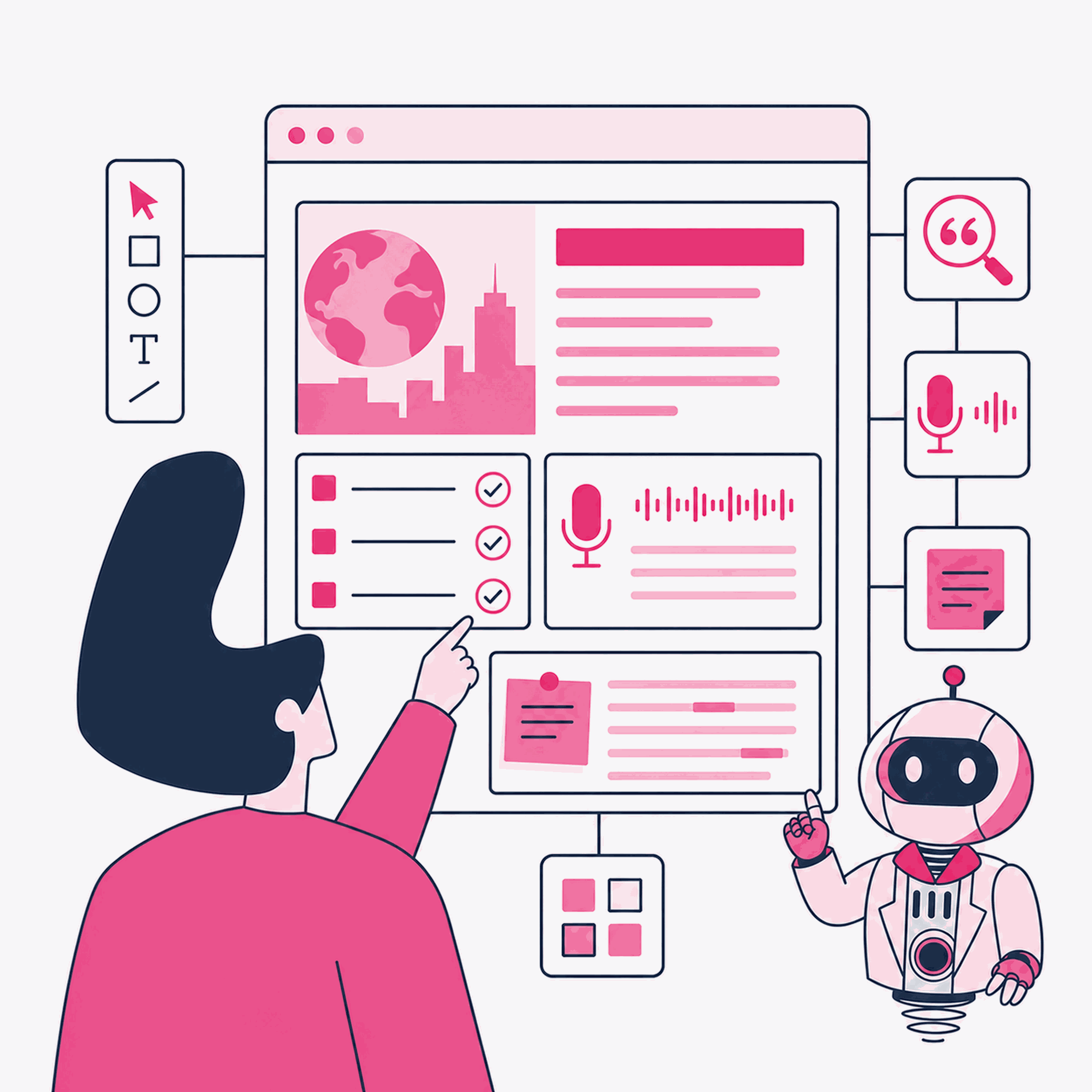
AI can speed research organization and transcription, including the first draft. It cannot sit through an interview or verify a fact against a document it has never seen. Nor can it answer for what runs under a byline. This training helps reporters use AI on real stories while keeping verification and source protection with a person. Every publication decision stays there too.
- modules
- 6
- hours
- 13
Why this training
Why AI for this team?
Tips, backgrounders, public filings, recorded interviews, transcripts, drafts, and correction logs make up a reporter's day. An ungoverned AI habit puts all of it at risk. A byline promises that a person checked the record and sat through the interview. That person will answer for every fact. Left unmanaged, a convenient drafting tool can smooth over quotes, skip corroboration, and put confidential material inside a consumer product.
Generative AI can speed the work behind that byline. It can organize research around a tip and clean a recorded interview into usable notes. A draft can then take shape from verified material. It cannot sit through the interview or verify an unseen document. Nor can it take responsibility for a byline. A person can hand off transcription cleanup and timeline-building, including the first draft. Every verification call and source relationship stays with the reporter. So does the decision to publish.
This program focuses on the reporter's own craft. It covers reporting research and interview support, verification checklists, drafting in a reporter's own voice, and the source-protection, correction, and disclosure habits that keep a byline trustworthy. Publication-wide concerns, such as headline and metadata production at high volume, archive systems, localization pipelines, newsletter and social repurposing, and organization-level editorial governance, belong instead to our related AI training for media and publishing. Before delivery, we adapt this syllabus to your beats, source types, and existing verification and correction process, the same way we do for every program in the AI training catalog.
Reporting research takes longer than the story allows
Backgrounders, public records, filings, and years of prior coverage sit behind every deadline. AI can help a reporter build a research timeline and surface gaps to chase, but every claim still needs a document or a person behind it before it goes in a story.
Interviews generate more material than a reporter can revisit
A single sit-down can run to pages of transcript and hours of tape, so AI-assisted transcription and note organization free a reporter to listen while the raw recording remains the record of what was said.
Fluent isn't verified
Language models write confident sentences whether or not the underlying claim is true. Training has to draw a hard line between drafting assistance and reporting: a generated summary is a starting point for verification, never a substitute for a second source.
Corrections cost more once AI is in the workflow
A smoothed-over quote or misattributed detail damages trust fast. An invented fact published under a byline does too, faster than trust can be earned back. Reporters need a working correction habit. They also need a clear disclosure habit when an AI-touched draft has to be unwound.
Sources trust reporters who protect them
Confidential sources and unpublished documents should never reach a consumer AI tool's servers. The same applies to pre-publication drafts. Newsrooms need a plain rule for what stays local and which tools are approved. It also has to keep a source's identity out of every prompt.
Syllabus
Training syllabus
AI foundations for reporting work
90 minBeginner
A grounded look at what generative AI can and cannot do inside a reporting workflow, and where a hallucinated fact or invented quote can enter a story unnoticed. Participants leave with a shared vocabulary and a clear line between drafting support and reporting judgment.
- How large language models produce fluent text regardless of accuracy
- Where AI genuinely helps a reporting workflow, and where it does not
- Recognizing a plausible-sounding but unverified claim
- Decisions the journalist keeps
- Choosing a first, low-risk task to try on a live story
Reporting research and background investigation
150 minBeginner
Reporters use AI to build an organized research plan from a beat or tip base, without letting a summary stand in for a document. The module builds a habit of tracing every research lead back to something checkable before it earns a place in a story.
- Turning a story idea into a research plan and question list
- Organizing public records and filings, with prior coverage, into a timeline
- Drafting background questions and follow-ups on named people or organizations
- Spotting gaps a summary glosses over and chasing them separately
- Keeping a research trail that shows where each fact came from
Interview preparation and transcription workflows
120 minBeginner
A practical workflow for recording and transcribing interviews. The organization step keeps the exact words a source used. Participants build interview guides and turn transcripts into usable notes while keeping the recording as the authoritative record.
- Building an interview guide from research gaps and a story angle
- Handling recording consent and notice, including on- or off-the-record terms
- Using transcription tools without letting cleanup drift from the exact quote
- Organizing transcripts by theme
- Flagging ambiguous or inaudible passages for a manual re-listen
Verification support and corroboration checks
150 minIntermediate
Journalists use AI to organize the corroboration work around a claim, cross-referencing dates, names, and figures against primary documents, while keeping final verification a human judgment call. The module treats AI output as one lead to check against primary sources.
- Cross-referencing a claim against documents and records, alongside prior reporting
- Building a corroboration checklist for names, dates, figures, and quotes
- Using AI to flag inconsistencies without treating the flag as proof
- Distinguishing an unverifiable claim from a merely unfamiliar one
- Deciding when a claim needs a second source before it runs
- Invented citations, unsupported statistics
Editorial drafting in the reporter's own voice
150 minIntermediate
Reporters move from verified notes and transcripts to a structured draft that still reads like their own reporting while working through an editor's queries and revising a draft without reintroducing unverified material.
- Structure from verified notes
- Keeping a reporter's own voice and framing through AI-assisted drafting
- Responding to editor queries without losing sourcing detail
- Rewriting a passage for clarity without changing what a source said
- Deciding which AI-suggested phrasing to keep or cut, then rewrite
Source protection and corrections with disclosure practice
120 minAdvanced
The closing module turns individual habits into a routine a newsroom or freelance reporter can run. It covers what never enters a consumer AI tool. It also covers corrections and what readers should be told about AI's role in a story.
- Keeping source identities and unpublished drafts, including documents, out of consumer AI tools
- Choosing approved tools and secure alternatives for sensitive reporting
- Running a correction once an AI-touched error reaches publication
- A plain-language disclosure practice
- Building a personal or newsroom checklist for source protection
- Planning a small pilot on one beat before wider adoption
Outcomes
Outcomes & audience
What you will learn
- Trace every fact back to a document
- Turn a recording into notes and quotes you can trust
- Flag a claim that still needs a second source
- Spot an invented quote early
- Draft a story that keeps the reporter's own voice and framing
- Rewrite a passage, sourcing intact
- A source's name stays out of every prompt
- Issue a correction and let the reader see it
Who should attend
- Reporters and correspondents across beats
- Investigative and enterprise journalists
- Freelance journalists and stringers
- Local and regional newsroom staff
- Bureau chiefs and senior reporters
- Journalism students and early-career trainees
Format
Training format
Newsroom practice takes about 13 hours, usually over two days or half-day sessions arranged around shift patterns and deadlines. Onsite and live-online formats cover the same workshop-led syllabus.
- Format
- Onsite or live online
- Duration
- 2 days (about 13 hours, can be split into half-day sessions)
- Group size
- Up to 20 participants per group
- Language
- English or Turkish
- Materials
- Research and verification checklists, interview templates, and exercise workbook
- Certificate
- Certificate of completion
About Zeo
Why Zeo
Zeo started in 2011 and now works out of San Francisco, Istanbul, Ankara, and Lisbon. We run Copilot Academy and organize Digitalzone, an international digital marketing conference. This program draws on the 10+ years of consulting and training work behind that, applied to corporate AI adoption.
- 2011founded in Istanbul
- 10+years of consulting and training experience
- 3offices: San Francisco, Istanbul, Ankara, Lisbon
Keep exploring
Related programs

 AI in Media & Publishing6 modules · 13 hoursNewsrooms, publishers, and editorial teams get hands-on generative AI training: research and transcript summaries, archive retrieval, metadata, localization, repurposing, and accountable publishing workflows.View training
 Using AI in Content Teams6 modules · 13 hoursAI training for content and editorial teams, scoped to your actual calendar: briefs, drafting, repurposing, and a house style that holds up across freelancers and every format derived from the piece.View training
 Perplexity Enterprise6 modules · 13 hoursInstructor-led Perplexity Enterprise training for research and knowledge teams: grounded search setup, a shared Space workflow, sourcing and citation judgment, and enterprise admin and data governance.View training
 AI Literacy & Prompt Engineering6 modules · 13 hoursAI literacy and prompt engineering training for your whole company. Teams practice on their own workflows across ChatGPT, Copilot, and Gemini, and walk out with a shared prompt library they use again the next day.View training
Next step
Let's design the program for your newsroom


Questions
Frequently asked questions
Who is AI training for journalists and newsrooms designed for?
It is designed for reporters and correspondents, investigative and enterprise journalists, freelance journalists and stringers, local and regional newsroom staff, bureau chiefs, and journalism students. Exercises are grouped by beat and experience level so early-career and senior reporters can work on relevant material without separate tracks.
Do reporters need prior AI experience?
Participants need no coding or data-science background. They should know their own beat and sourcing habits. Their verification steps matter too. General model and prompt concepts are introduced in context. Teams wanting a broader starting point can take the dedicated AI literacy and prompt engineering program first.
What does the schedule look like?
The core syllabus is about 13 hours, delivered onsite or live online, over two days or as half-day sessions split around deadlines and shift patterns so reporters stay available for breaking coverage between sessions.
Can the syllabus reflect how our newsroom works?
Yes, and that happens before day one. During a discovery call we review your beats, source types, existing verification steps, and approved tools. The exercises are then built around your actual workflow. Confidential sources and unpublished drafts still get replaced with anonymized or synthetic material. Sensitive documents do too unless your organization already runs a sanctioned environment.
Does this training write stories or verify facts automatically?
No. The program does not build autonomous publishing or fact-checking systems, and it does not teach or condone generating quotes or facts. Participants practice using AI to prepare research, transcripts, and drafts faster while keeping verification, source judgment, corrections, and every publish decision with an accountable person.
How is this different from AI training for Media & Publishing?
This program is built around the individual reporter's craft: research, interviews, verification support, drafting, source protection, corrections, and disclosure on a single story. Newsroom-wide production and audience concerns belong to our separate AI training for media and publishing instead: headline and metadata systems at high volume, archives, localization, newsletters, social repurposing, and organization-level governance.
How do you protect sources and unpublished material during training?
Confidential sources and unpublished drafts never enter unapproved consumer AI tools during the program. Sensitive documents stay out too. We define what may enter each tool and what must stay local or off any prompt entirely. If your organization already has approved enterprise tools, we adapt the workshop to those boundaries.
What does a newsroom program cost, and what stays with us?
Pricing depends on group size, delivery format, customization depth, and location, so a tailored proposal follows the discovery call. Your reporters keep the checklists and templates created in the sessions, and follow-up or advanced workshops can be planned as your practice matures.