



AI Training · AI Agents
AI Agents Training for Business Teams
A chatbot answers a question. An agent reasons toward a goal, uses tools, and takes multi-step action on its own. This training teaches business and operations teams to build agents on no-code platforms and govern them responsibly, on the workflows you run every day.
- modules
- 6
- hours
- 13
Why this training
Why master this AI skill?
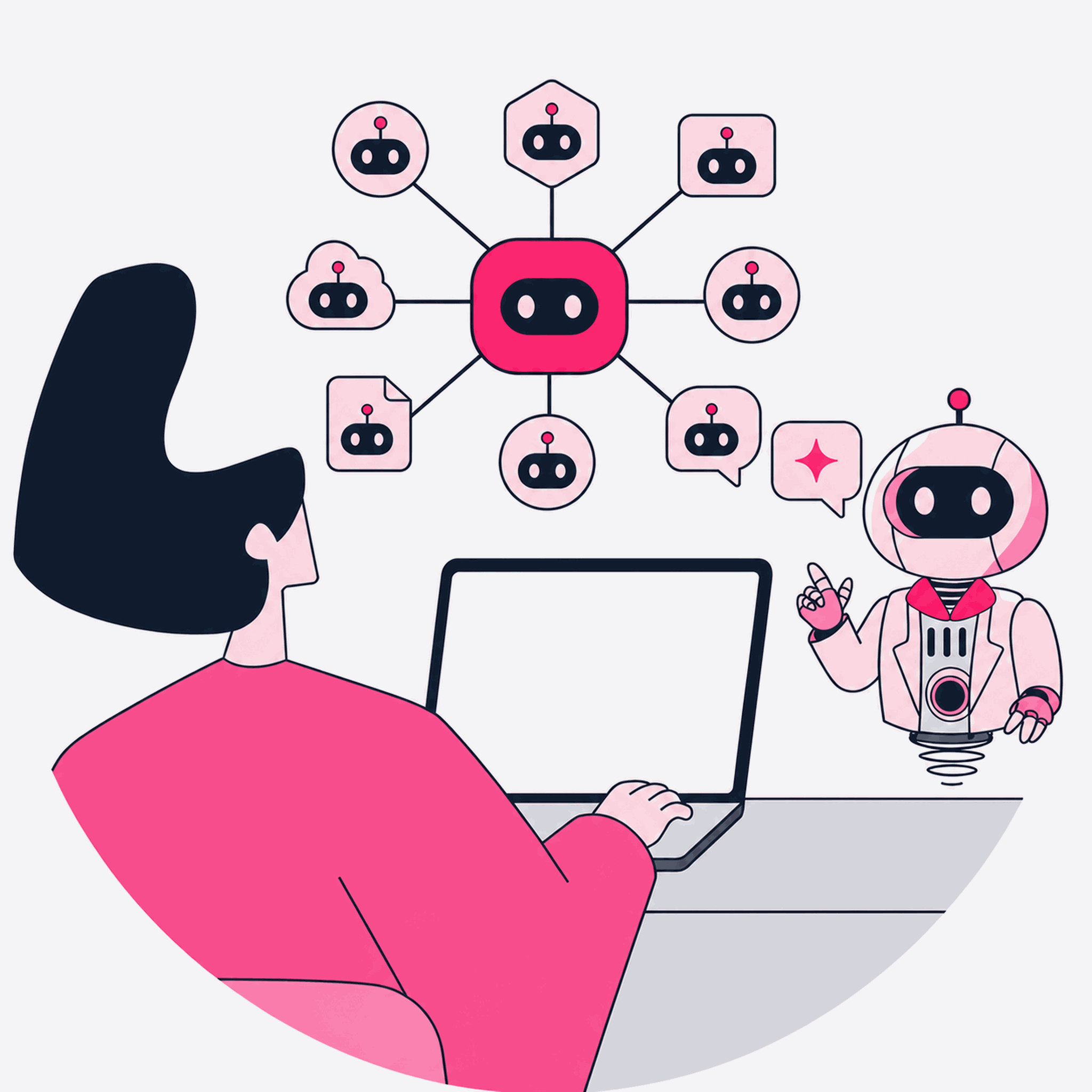
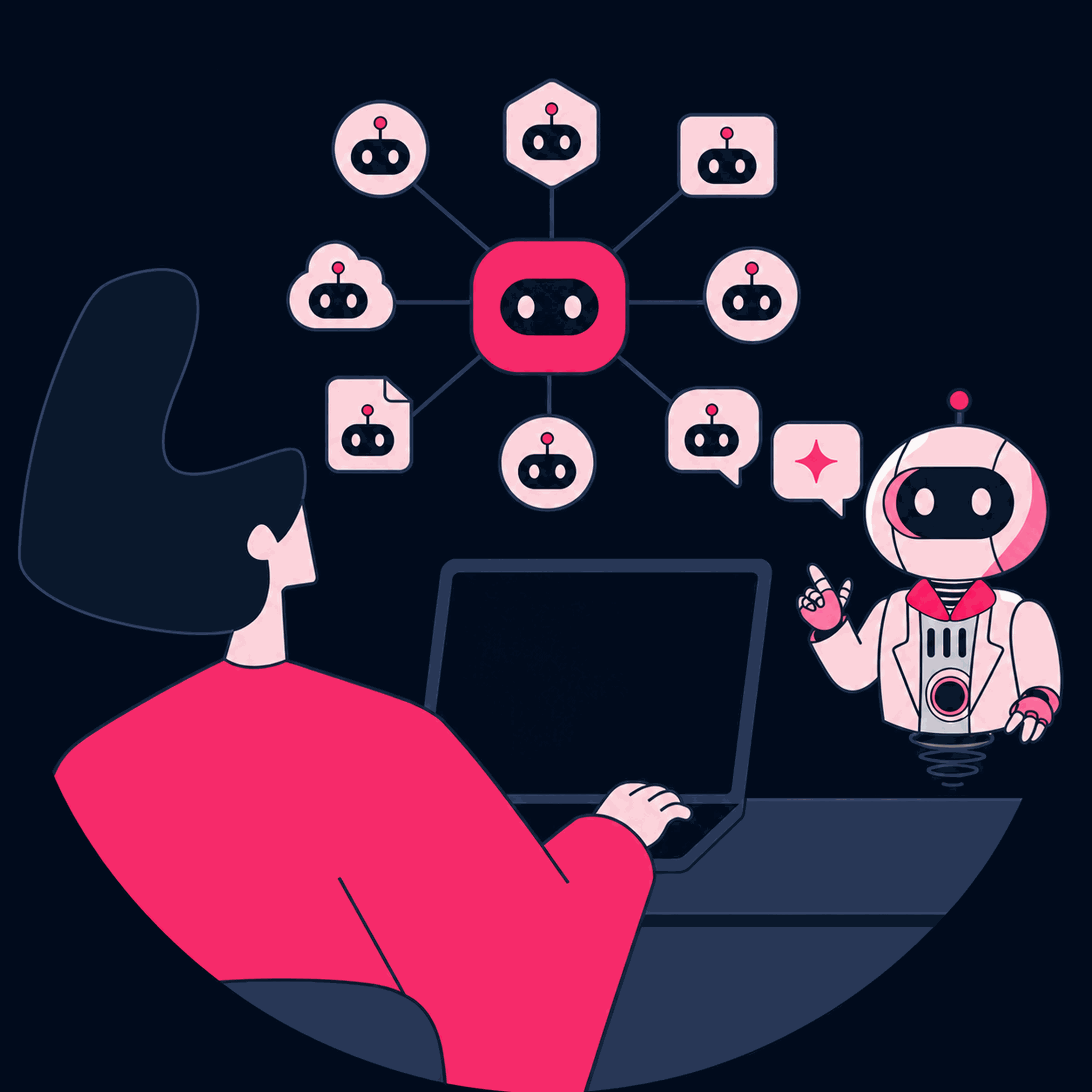
Most people assume an agent is just a chatbot with extra steps. That's the common mistake: a chatbot waits for a question. Give an agent a goal and it reasons through the steps. It calls tools and takes action on its own.
That distinction is why boards named agents the priority for 2026, and why last year's ChatGPT training doesn't feel like enough anymore. An agent that acts on its own can reach further into your systems than a chatbot ever could. That reach is exactly what makes the setup worth doing carefully.
This is a business program. Nobody leaves able to hand-build a framework in Python. They leave able to decide which processes deserve an agent versus a fixed automation workflow. They also build one on a no-code platform and learn to govern it responsibly.
A dedicated module covers governance through data access and monitoring. It also explains what KVKK and GDPR expect from systems that act without a person approving every step. What you build here is something you can trust once it's live. The AI training catalog keeps this business-agent track separate from tool and role programs.
A chatbot answers, an agent acts
A chatbot waits for a question and replies. Give an agent a goal instead, and it reasons through the steps, uses tools, and takes multi-step action with little hand-holding. That changes what your team can delegate, and it raises the bar on how carefully you set the thing up.
The board named agents the 2026 priority
Leadership has heard that agents are the next step, and teams are being asked to show results fast. Most teams overreach at first, scoping a full agent for a process that only needed a simple workflow. Knowing which processes genuinely deserve the autonomy is the harder skill, and it's the one this program teaches first.
Why did last year's ChatGPT training fade?
Many organizations ran a ChatGPT session in 2025 and watched usage fade. Agents stick when people can scope and build them, with governance in place. This program is built around your own workflows so the habit survives.
No-code puts agent-building in business hands
Platforms like Copilot Studio, custom GPTs, and agent builders let marketing, ops, and support teams ship a working agent without writing code, which makes design and judgement the skill that matters now.
Guard the data before you grant the autonomy
An agent that acts on its own can reach data and systems a chatbot never touches. This program builds guardrails, human-in-the-loop checkpoints, and KVKK-aware governance into the agent from day one, before anything goes live.
Syllabus
Training syllabus
From chatbots to agents: what agentic AI really is
90 minBeginner
A hype-free grounding before anyone builds anything: what separates a chatbot from a workflow, then what makes a true agent. The module also explains why an agent's autonomy is both its value and its risk.
- What separates a chatbot from a workflow, then from a true agent
- The anatomy of an agent: model, tools, memory, and planning
- When a simple workflow beats an agent, and when it doesn't
- Where autonomous agents already show up in tools you use
- Realistic first use cases
Choosing your agent-building stack
90 minBeginner
The no-code and low-code options, and how to pick between them: where each platform is strong, what it actually costs to run agents day to day, and how to match a stack to your team's skills and data.
- No-code and low-code platforms: Copilot Studio, custom GPTs, and agent builders
- OpenAI Agent Builder and vendor agent platforms at a glance
- Where deterministic automation tools like n8n and Make fit, and where they don't
- Build-versus-buy and the real cost of running agents
- Matching a platform to your team's skills and data
Building your first business agent, hands-on and no-code
180 minIntermediate
The core build session starts with one live process. Your team gives the agent the knowledge and tools it needs, then sets its boundaries. A working agent goes live in the room.
- Scoping one live process from your own work
- Knowledge sources and connected tools, given to the agent
- Instructions, boundaries, guardrails
- Testing an agent against edge cases before you trust it
- A working agent, published live in the session
- A reusable design brief for the next agent
Agents for your department's workflows
150 minIntermediate
The highest-value agent patterns per function, worked on your own material: research and reporting, content QA, support triage, and lead qualification. You leave with a playbook built around your own functions.
- Research and reporting agents for marketing and SEO
- Content review and quality-assurance agents
- Support triage and customer-response agents
- Lead qualification and routing agents
- A per-function playbook
Multi-step and multi-agent workflows
120 minIntermediate
For when a single agent runs out of runway. This module covers orchestrating several steps and several agents without losing control, with human checkpoints and safe fallbacks built in from the start.
- Orchestrating several steps without losing control
- Human-in-the-loop checkpoints and approvals
- Escalation paths and error handling, with safe fallbacks
- Handoffs between agents, and back to a person
- Keeping a multi-agent system observable
Governance and secure rollout
150 minAdvanced
What it takes to trust an agent once it's live. Data access, KVKK and GDPR obligations for systems that act on their own, ongoing monitoring, and a pilot-to-scale plan you can actually measure.
- Data access and permissions for autonomous agents
- KVKK and GDPR obligations for agents that act on their own
- Agent output, evaluated and monitored over time
- Logging and audit trails for accountability
- A pilot-to-scale plan with measurable ROI
Outcomes
Outcomes & audience
What you will learn
- The chatbot-versus-agent line, obvious now
- Reject agents not worth building
- Build and publish a working agent on Copilot Studio or a custom GPT
- Connect an agent to your knowledge sources and tools, with guardrails set
- Set human-in-the-loop checkpoints and safe fallbacks
- Govern agents under KVKK and GDPR: access, logging, oversight
- Track agent output before launch, then after it ships
- Plan a pilot-to-rollout path anyone can measure
Who should attend
- Digital and growth leads, including marketing
- Operations and business-transformation managers
- Innovation and AI-adoption owners
- Customer support and service team leads
- Product managers and analysts exploring agents
- HR and L&D leads running AI-upskilling programs
Format
Training format
Agent-building takes two days, usually split into half-day sessions. Onsite and live-online formats cover the same syllabus, and the build modules work best when participants bring their own processes to work on.
- Format
- Onsite or live online
- Duration
- 2 days (about 13 hours, can be split into half-day sessions)
- Group size
- Up to 20 participants per group
- Language
- English or Turkish
- Materials
- Agent design briefs, a prompt library, and an exercise workbook
- Certificate
- Certificate of completion
About Zeo
Why Zeo
Zeo started in 2011 and now works out of San Francisco, Istanbul, Ankara, and Lisbon. We run Copilot Academy and organize Digitalzone, an international digital marketing conference. This program draws on the 10+ years of consulting and training work behind that, applied to corporate AI adoption.
- 2011founded in Istanbul
- 10+years of consulting and training experience
- 3offices: San Francisco, Istanbul, Ankara, Lisbon
Keep exploring
Related programs
 AI Automation with n8n6 modules · 13 hoursAI automation training for ops and marketing teams: build, test, and govern workflows with n8n, keep a person in the loop where it matters, and hold clear data boundaries throughout.View training
 OpenClaw6 modules · 12 hoursInstructor-led OpenClaw training for business teams piloting a fast-moving, self-hosted personal AI assistant: a contained setup, scoped business workflows, review discipline before anything ships, and a governed call on whether to roll it out.View training
 Hermes Agent6 modules · 13 hoursInstructor-led Hermes Agent training for business and operations teams: safe self-hosted setup and scoped business workflows under human-in-the-loop governance for a fast-moving open-source agent.View training
 Salesforce Agentforce6 modules · 13 hoursInstructor-led Salesforce Agentforce training for CRM teams: agent and topic setup, grounding on Salesforce data, guardrails, and a governed rollout across service and sales workflows.View training
Next step
Let's scope your first agent build
Questions
Frequently asked questions
What exactly counts as an "agent," versus just a chatbot?
A chatbot answers a question and stops there. An agent gets a goal and works toward it. It reasons through steps and uses tools, then takes action with limited supervision. In practice, that means an agent can research, draft, update a record, or trigger a task on its own, where a chatbot only responds. This training makes that line clear before it teaches anything else.
Do we need developers on the team for this?
No. The whole program runs on no-code and low-code platforms, built for business and operations people: marketing, operations, innovation, support, product. The people who own the workflow are the ones who end up building the agent.
Does anyone need to already know how to code?
No. If your team can use everyday business software and describe their own processes clearly, they can build an agent here. Coding and data-science backgrounds aren't part of the bar. A separate technical track can be scoped on request for anything developer-deep, like custom frameworks.
How long does it take, and where does it run?
Two full days, about 13 hours, delivered onsite, live online, or in half-day blocks so daily work keeps moving, with the build modules landing best when participants work on their own live processes.
Which platforms does the build session use?
Mainstream no-code tools carry the core skills: Microsoft Copilot Studio, custom GPTs, and current agent builders, with an overview of OpenAI Agent Builder and other vendor platforms. Deterministic automation tools like n8n and Make come up only at the level of knowing when they fit better than an agent. Building those pipelines is what our AI automation training covers instead.
Will we build something on our own workflow, or just watch a demo?
In the build modules, your team scopes a live process, builds a working agent on it, and publishes it before the session ends. We run a short discovery call beforehand so the platforms and depth match your systems, and what you leave with is ready to use.
How do governance and KVKK change once an agent is live?
A full module covers it. Because an agent acts on its own, data access, permissions, monitoring, and audit trails matter more than they would for a simple chatbot. We work through what KVKK and GDPR expect from autonomous systems, and help you set guardrails, human checkpoints, and a governance policy your team will follow in practice.
What decides the number?
Group size, delivery format, customization depth, and location decide it, so no two quotes look alike. Share your teams and the workflows you have in mind, and we'll price a proposal for that scope specifically.